

Purpose of this document:
A guide for contractors on how to handle every cold inbound lead (calls and form fills). Covers manual & automated strategies. Works for owner-led sales and for companies with a CSR.
There are two main ways a prospect will make first contact with you. A phone call, and form fill.
Inbound Phone Call
When the phone rings
ANSWER THE FREAKING PHONE
This is the most basic rule, and the most expensive one to get wrong.
Your chances of turning a prospect into a customer if your first interaction with them is a missed a phone call are very low.
I highly recommend tracking your pick-up rate so you know exactly how many calls are going unanswered. You can then multiply that by your average cost-per-lead and see exactly how much money you “threw away”.
If you're an owner-operator
And it’s your personal cell that rings, then it’s going to be hard to always answer the phone. Especially if you’re in the middle of working with a customer. You should hire someone to help with this. If you can spend money on ads you can spend money on an answering service.
BUT, if it’s just you answering, I have some tips below on how to handle missed calls.
Answer SPEED matters too
Most phone’s ring for 30 seconds. If you have some sort of phone-chaining or answering service, it might ring for even longer.
And prospects WILL HANG UP if the phone rings too long. ESPECIALLY past that 30 second mark.
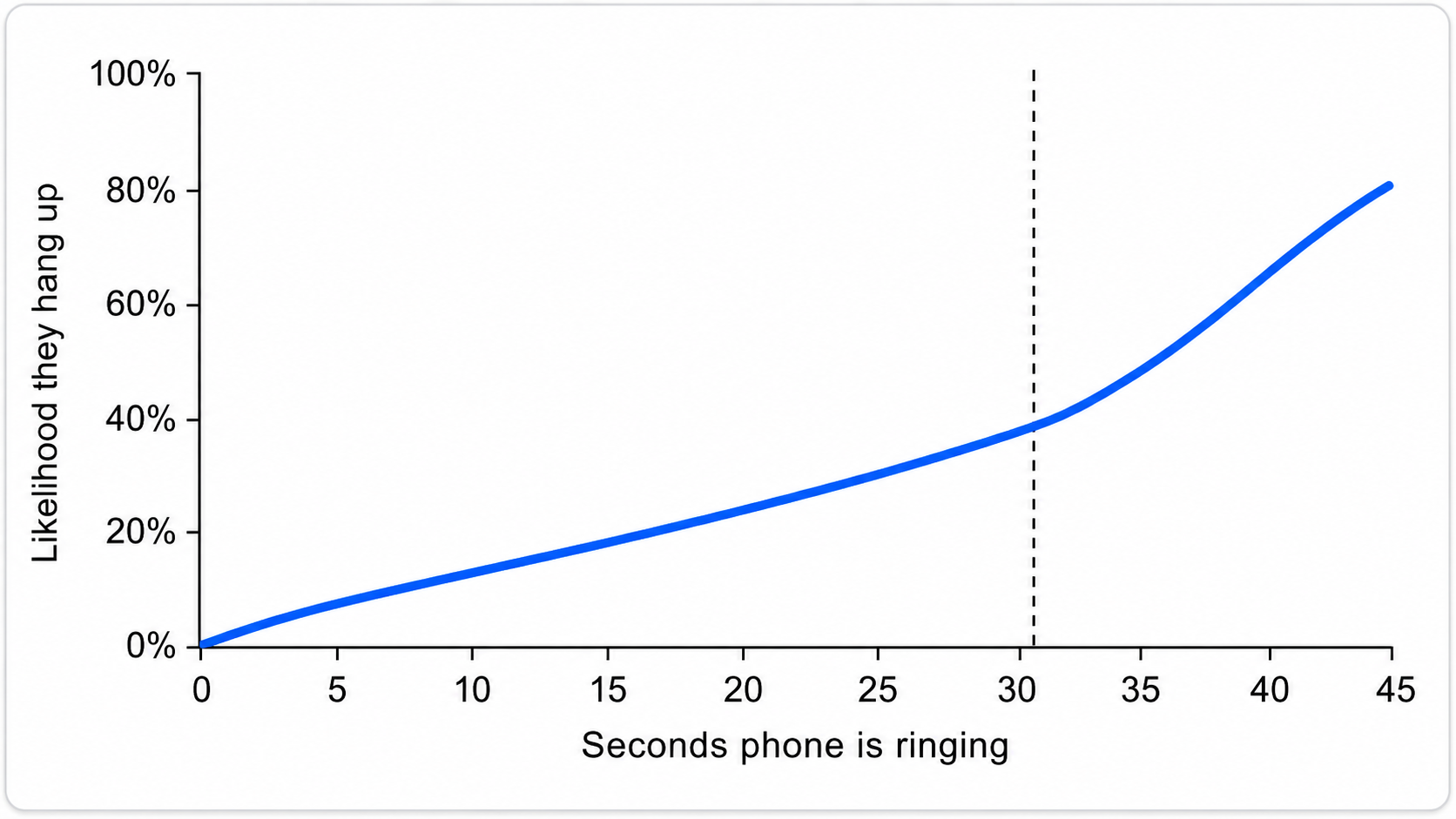
Answering quickly (within the first 15 seconds) will pretty much eliminate any “ringing-hang-ups” you might have.
A ringing-hang-up and caller getting sent to voicemail are both missed calls and both hurt your bottom line.
The other benefit of answering fast
Not only will you reduce missed calls, but you will make a great first impression with a prospect. We are in the “service” industry, and SPEED (and customer service) is something customers value extremely highly.
When you pick up
Friendly, professional, helpful, concerned. Say the business name and ask how you can help.
“Good morning, you’ve reached Tyler’s Plumbing - This is Tyler, how can I help you today?”
Some businesses will have a little “flavor” in their greeting as a branding play. Something like: “how can I make you smile today?“. These can be good, just make sure it’s not too confusing for the prospect what you’re asking them.
You should have 3 goals when answering an inbound call:
- Qualifying the lead
- Booking the appointment
- Building trust
We are NOT trying to:
- Sell them on the call
- Quote a price over the phone
- Collect a deposit
- Close the deal
That third goal, building trust, is what separates a good contractor from a great one.
And a great way to build trust is to seamlessly blend qualifying and discovery.
The energy is CONCERNED CURIOSITY. Like we genuinely care what’s going on at their house and we’re curious about it. Not like we’re filling out a form.
The wrong version (sounds like a checklist):
“Can I get your name? What’s your address? What’s the problem? When do you need it done?”
That’s an intake form said out loud. The prospect feels like a number and it’s off-putting. Their “Sales wall” starts to go up. They start asking about price immediately because they’re trying to escape.
The right version (sounds like a conversation):
“Hey Mr. Prospect, how can I help you today?” “Got it. What’s your situation? Walk me through what’s going on.” “Okay, and how long has this been going on?”
We’re getting them to open up. The qualifying info we actually need (name, address, service, urgency, decision-maker, budget) comes out naturally inside their story. We don’t always have to ask for it directly.
Branch on what they care about most
Inside the first minute or two, the prospect will tell us what matters to them. Listen for it, then mirror it back with more questions.
| If they care about… | Our follow-up questions sound like… |
|---|---|
| Speed | ”When were you hoping to get this handled?” “Is this an emergency or more planned?” “How soon do you need someone on site?” |
| Quality / craftsmanship | ”What was the last contractor’s work like?” “Anything specific you want done differently?” |
| Design / look | ”Have you seen something you liked? Pinterest, neighbor’s house, anywhere?” “What’s the look you’re going for?” |
| Price | (Don’t anchor here. Loop back to their situation, then book the in-home.) |
If they push hard for a price on the call:
The move is to acknowledge the question and redirect to the in-home. “Totally get it, I want to give you a real number, not a guess. That’s why we come out for a quick look. Wednesday afternoon or Thursday morning, which works better?”
Lead Form
When a form fill comes in
Call them. As fast as humanly possible.
Speed matters more than what we say. The form-fill prospect is a hot lead for about five minutes, then they’re back to comparing tabs, then they’re calling someone else.
While we’re picking up the phone, an automated text should ALREADY be firing on their phone:
“Hey, this is Tyler from Tyler’s Plumbing. Just saw your form submit, I’ll give you a call here in a second.”
The text has to look HUMAN. Not automated, not branded, not “Thank you for submitting your inquiry, a representative will contact you shortly.” That reads like a robot and the prospect tunes it out.
Two variants depending on who runs the phone:
If it’s just you in the field: the text should read like we typed it ourselves. Casual, first person (“Hey, this is Tyler”), throw a typo in there if we have to (most real texts have one). The goal is the prospect reading it and thinking “oh, this is the actual owner.”
If you have an office manager handling the phone: the text can sound a little more put-together, but still human. From the business name, not from a generic auto-system. “Hey, Tyler’s Plumbing here. Got your form, calling you in a second.”
Important
The purpose of the automated text is hold them over until we call. It is NOT to have a sales conversation over text.
Also, if you text them saying you are going to call them, then you need to actually call them.
Other Scenarios
When you miss an inbound call
If we somehow miss an inbound call (in the field, on another call, whatever), get a text out within minutes. Concerned-curiosity tone, just like we’d answer.
“Hey, sorry I missed you. This is Tyler from Tyler’s Plumbing, in the field right now. I’ll get back to you within a few minutes.”
What we’re doing with this text is buying time without losing the lead. The prospect knows we exist, knows we saw their call, and knows there’s a real human on the other end. That hopefully stops them from instantly calling the next contractor.
When the callback doesn’t connect
We called them back and they didn’t pick up. Same concerned curiosity, just over voicemail and text.
The voicemail:
“Hey Mr. Prospect, this is Tyler from Tyler’s Plumbing returning your call. Wanted to see what’s going on with the [situation they mentioned], give me a call back when you get a second.”
Text right after the voicemail:
“Hey, just left you a voicemail. Tyler from Tyler’s Plumbing. Let me know when’s a good time to chat.”
If we don’t hear back in a few hours, call again. Mix calls and texts over about a week or two. Roughly four total touches.
Sample cadence:
| Touch | When | What |
|---|---|---|
| 1 | Within 5 min of the lead | Call + auto-text |
| 2 | A few hours later (same day) if no response | Call + text |
| 3 | Day 3 or 4 | Call + text |
| 4 | Day 7 to 10 | Call + final text (“hey, last check, still interested?“) |
After 4 touches with no response, you start to get diminishing returns and risk just annoying them.
Important: Every touch references their specific situation. Not “checking in” or “following up.” Always tied to what they originally reached out about. “Wanted to see if you got the water heater situation handled” lands. “Just following up” doesn’t.
When it comes in after hours
A call or form fill at 9pm on a Tuesday or 11:30pm on a Saturday is a different scenario than 2pm on a Wednesday.
Default play: reach out first thing in the morning. Phone call, not text.
Optional same-night callback: only if you can do it within FIVE MINUTES of the lead coming in. Anything past 5 minutes at night and you risk insulting them by calling too late.
The after-hours auto-text should read differently than the main version:
“Hey, Tyler from Tyler’s Plumbing. Just saw your form, we’re closed but I’ll give you a call first thing in the morning. If it’s an emergency, call me directly at [number].”
Putting it all together
The TL;DR action list. Pull this up on your phone before the next lead hits.
📞 When the phone rings:
- Answer immediately
- Business name + “how can I help you today”
- Never go to voicemail during business hours
📝 When a form fill comes in:
- Call immediately, fast as humanly possible
- Auto-text fires at the same moment (looks human, NOT branded-corporate)
- Solo operator: text reads like we typed it (throw in a typo)
- Office manager: still casual, still human, from the business name
📵 When you miss an inbound call:
- Recovery text within minutes (“in the field, get back to you in a few”)
- Then actually call them back fast (within the hour)
💬 On the call:
- CONCERNED CURIOSITY, not a checklist
- Open with “what’s your situation / what’s going on”
- Branch on what they care about (speed / quality / design)
- Goal: book the in-home. NOT sell on the call.
- If they push for price: acknowledge, redirect to the in-home
☎️ When the callback doesn’t connect:
- Voicemail (concerned curiosity, ask for a callback)
- Text right after the voicemail
- ~4 touches over 1-2 weeks, text + call mixed
- Every touch references their specific situation
- After 4 touches, let them go
🌙 After hours:
- Default: morning callback (phone, not text)
- Same-night callback ONLY within 5 min of the lead
- Past 5 min at night: morning only
- Auto-text can vary from the business-hours version